Yellowfin Tuna
SaltwaterIn season now

Yellowfin Tuna

Thunnus albacares

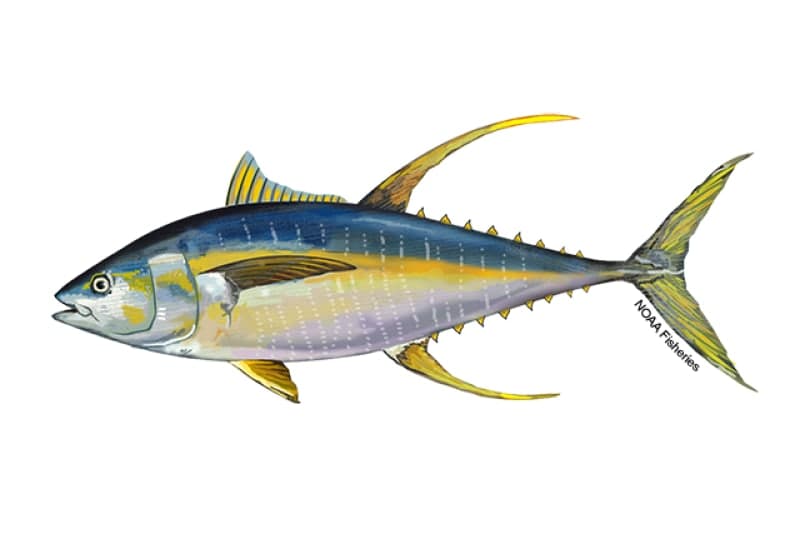
The bluewater prize of the Gulf canyons and Northeast floaters — chrome-and-gold rockets with long yellow sickle finlets that test 50-wide tackle and the angler holding it. The tuna most US offshore crews chase.

Typical size
30–100 lb
Trophy class
200 lb+
Challenging

Run to the break, the floaters, or the canyon. Troll a ballyhoo spread to find them, then live-chunk or pitch baits/poppers to the feeding school. In the Gulf, oil platforms in 1,000+ ft are the classic address.

Quick Catch Plan

Best bait right now
Live hardtail (blue runner) or a chunk of butterfly/butterfish drifted in a chunk slick
Recommended lure
Trolled ballyhoo (naked or skirted), cedar plugs, and topwater poppers on busting fish
Setup
50-wide conventional (troll) or 8000–14000 spinning with 65–100 lb braid for run-and-gun
Where to go
Canyons, floaters/oil rigs, temperature breaks, and weedlines in 600–3,000+ ft
Best time
Dawn bite; night chunking on anchor/drift at the rigs and canyons
Season notes
Gulf yellowfin bite year-round around deepwater floaters; the Northeast canyons fire up mid-summer through fall.

ID Characteristics

Use these field marks and context clues to separate yellowfin tuna from similar fish before logging or keeping one.

  • Overall look: The bluewater prize of the Gulf canyons and Northeast floaters — chrome-and-gold rockets with long yellow sickle finlets that test 50-wide tackle and the angler holding it. The tuna most US offshore crews chase.
  • Typical size: 30–100 lb; trophy class: 200 lb+.
  • Most likely setting: offshore in Gulf Coast, Atlantic Coast, Northeast, Florida, Southeast.
  • Where to confirm it: Clean blue water, breaks/rips, birds, flying fish, and porpoise pods pushing bait.
  • Compared with Bigeye tuna: Bigeye have a noticeably larger eye, shorter finlets, and lack the long second-dorsal/anal lobes big yellowfin grow; bigeye body is rounder and deeper.
  • Compared with Blackfin tuna: Blackfin stay small with dusky finlets; yellowfin have bright-yellow finlets edged in black and grow far larger.

Gear Recommendations

Rod
Troll: 50-wide stand-up. Run-and-gun: 7'–8' heavy popping/jigging spinning
Reel
50-wide conventional (troll) or 14000–20000 spinning (cast/jig)
Main line
80–100 lb braid (spin) or 80 lb mono (troll)
Leader
60–130 lb fluorocarbon; heavier for trolling, lighter (40–60) when chunking pressured fish
Hooks
7/0–9/0 circle for bait/chunk; strong 4/0–6/0 trebles/singles on lures
Jigheads
n/a; vertical/knife jigs 150–300 g
Terminal tackle
Fluoro wind-ons for trolling; long straight fluoro leaders for chunking
Lure sizes
Ballyhoo, 6–9" skirts, cedar plugs, 4–6" poppers/stickbaits
Lure colors
Blue/white, black/purple, pink; natural ballyhoo
Baits
Live blue runners/hardtails · Butterfish/sardine chunks · Live pinfish/threadfins · Flying fish (troll)
Beginner setup

Get on a reputable offshore charter or overnight canyon trip — the crew supplies heavy tackle and the know-how.

Budget setup

Split a shared overnight canyon/rig run; bring one heavy jigging/popping combo.

Serious angler

Full trolling spread + live-chunk program, quality electronics to read breaks and marks, and a night-chunk anchor game at the floaters.

Techniques

Presentation
Troll to locate, then match the feed: drift natural chunks in a steady slick, or pitch a lively bait/popper into busting fish. Drop leader size when they get picky.
Retrieve
Chunk: free-spool with the sinking chunks, no drag on the bait. Poppers: long sweeps with pauses. Jigs: fast lifts through marks.
Positioning
Set up up-current and let the slick pull fish to the boat; on troll, work the up-current edge of breaks and rips.
Depth
Surface to a couple hundred feet; jig deeper marks by day.
Structure
Canyons, deepwater oil platforms/floaters, seamounts, temperature/color breaks, weedlines.
Working current
Edges where currents collide (breaks, rips) concentrate bait and tuna.
boat fishing

Entirely a boat fishery — trolling, chunking, jigging, and casting to schools offshore.

Timing & Conditions

Seasons
Gulf: year-round at the floaters. Northeast canyons: summer into fall.
Time of day
Dawn is prime; night chunking under lights is deadly at the rigs/canyons.
Weather
Weather-window fishery — pick settled offshore forecasts.
Wind
Long runs demand light-to-moderate wind and safe seas.
Water temp
Best 72–82°F; hunt clean blue water and temp breaks.
Tides
Current edges matter more than tide stage this far out.
Moon
Night chunking often best around the moons with strong current.
Pressure
Minor offshore.
Seasonal movement
Highly migratory, following bait and thermal fronts across the basin.

Habitat — Where to Find Them

Open bluewater over deep structure and thermal breaks — canyons, floaters, and seamounts far offshore.

Depth range
Surface to ~800 ft over 600–3,000+ ft of water.
Look for
Clean blue water, breaks/rips, birds, flying fish, and porpoise pods pushing bait.
Migration
Ocean-basin migrations tracking bait and water temperature.
canyonsoil platforms/floatersseamountstemperature breaksweedlines

Common Mistakes

  • Chunking with the reel in gear — a dragging chunk looks unnatural and gets refused
  • Leader too heavy for pressured or hard-fingered fish
  • Running offshore without watching the temp/chlorophyll charts
  • Under-gunned drag/tackle for a fish that never quits
  • Not bleeding/icing fast — the difference between sashimi and dog food

Catch, Handling & Release

Landing
Gaff decisively behind the head; big fish need two gaffs and a plan.
Handling
Bleed immediately (cut gills + tail), then ice-slurry — quality is everything with tuna.
Release
Revive smaller/undersized fish boatside with water flowing over the gills before release.
Conservation
Atlantic yellowfin: 27" curved fork length minimum and a 3-fish/person daily limit under NOAA HMS rules; an HMS permit is required to fish federal waters. Verify current limits before every trip.

Common Lookalikes

Bigeye tuna

Bigeye have a noticeably larger eye, shorter finlets, and lack the long second-dorsal/anal lobes big yellowfin grow; bigeye body is rounder and deeper.

Blackfin tuna

Blackfin stay small with dusky finlets; yellowfin have bright-yellow finlets edged in black and grow far larger.

Guide data is editorial and general — conditions, regulations, and fish behavior vary by water. Photo: NOAA Fisheries.