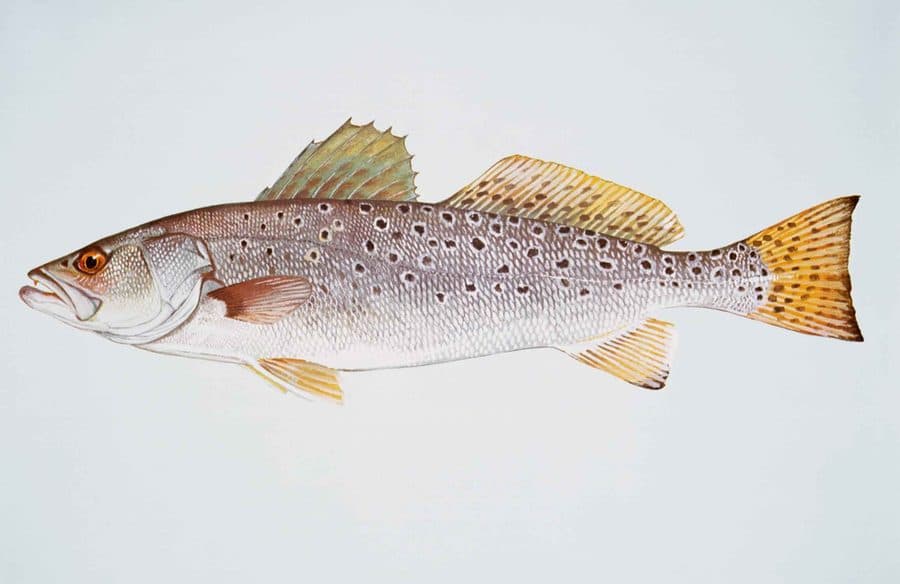
Speckled Trout (Spotted Seatrout)
Cynoscion nebulosus
The Gulf and Southeast's everyday inshore target — a soft-mouthed, spotted predator that schools over grass flats and eats shrimp like popcorn. Big solitary 'gator trout' are a genuine trophy.
Drift grass flats with shrimp under a popping cork or a soft plastic hopping the potholes. Follow temperature: deep in cold and heat, flats in the sweet seasons.
Quick Catch Plan
ID Characteristics
Use these field marks and context clues to separate speckled trout (spotted seatrout) from similar fish before logging or keeping one.
- Overall look: The Gulf and Southeast's everyday inshore target — a soft-mouthed, spotted predator that schools over grass flats and eats shrimp like popcorn. Big solitary 'gator trout' are a genuine trophy.
- Typical size: 14–20 in; trophy class: 24 in+ / 5 lb+ ('gator trout').
- Most likely setting: flats, inshore, marsh, pier, surf in Gulf Coast, Southeast, Atlantic Coast, Florida.
- Where to confirm it: Slicks (oily patches smelling like watermelon), bait showers, and diving terns.
- Compared with Weakfish: Weakfish (Atlantic) have smaller spots that don't extend onto the tail and dorsal fin like a speck's do.
- Compared with Sand seatrout: Sand trout are pale with no distinct spots.
Gear Recommendations
- Rod
- 6'10"–7'2" ML-M extra-fast spinning
- Reel
- 2500–3000
- Main line
- 10–15 lb braid
- Leader
- 15–20 lb fluorocarbon, 24"
- Hooks
- #1–2/0 kahle or circle for shrimp/croaker
- Jigheads
- 1/16–1/4 oz
- Terminal tackle
- Popping/rattling corks
- Lure sizes
- 3–4" plastics, 4" twitchbaits and topwaters
- Lure colors
- Chartreuse/white, opening night, plum, bone topwaters
- Baits
- Live shrimp (universal) · Live croaker (TX big-trout bait) · Finger mullet · Live pinfish
7' ML combo, cork + shrimp, drift a grass flat. Done.
Jighead + paddletail assortment replaces the bait bucket.
Wade-fishing belt with stringer and pliers, topwater/twitchbait box for trophy hunts, dock-light night program by kayak.
Techniques
- Presentation
- Cork rigs: pop-pop-pause; strikes come on the pause. Plastics: hop across potholes and let it fall.
- Retrieve
- Moderate with pauses; trout hit falling baits. Walk-the-dog steady for topwaters.
- Positioning
- Drift or wade with the wind across flats, fan-casting; anchor only on a proven bite line.
- Depth
- 2–6 ft flats; 8–15 ft channels/holes in temp extremes.
- Structure
- Grass/sand potholes, channel edges, oyster, dock lights, surf guts.
- Working current
- Tide-driven drift lines carry shrimp — set your drift to cross them.
Drift and fan-cast; power-pole when you hit a school.
Night lights: free-line live shrimp at the shadow edge.
Calm mornings, trout stack in the first gut chasing whitebait.
Same drill with stealth; a kayak on a calm dawn flat is deadly.
Wade-fishing IS the classic method — shuffle your feet (rays) and fish potholes.
Timing & Conditions
- Seasons
- Spring and fall peak; summer early/late and at night; winter in deep muddy holes on warm afternoons.
- Time of day
- First light is trout o'clock; night lights all summer.
- Weather
- Stable weather; specks hate fronts more than reds do.
- Wind
- Under 15 mph and fishable; find the lee shoreline.
- Water temp
- Active 55–88°F; big kills happen in hard freezes — fish deep canals after cold snaps.
- Tides
- Incoming across flats is classic; outgoing at drains and channel mouths.
- Moon
- Strong tides = better flats movement; full-moon nights light up dock fishing.
- Pressure
- Post-front: drop to deep holes and slow way down.
- Seasonal movement
- Flats (spring/fall) → passes and surf (summer spawn) → deep holes/rivers (winter).
Habitat — Where to Find Them
Seagrass estuaries from Chesapeake Bay to Texas — the definitive Gulf flats fish.
- Depth range
- 2–15 ft.
- Look for
- Slicks (oily patches smelling like watermelon), bait showers, and diving terns.
- Migration
- Short seasonal shifts within the estuary system.
Common Mistakes
- Ripping the cork instead of popping and pausing
- Fishing dead-calm heat mid-day on shallow flats
- Horsing fish — the soft mouth tears; keep steady light pressure
- Retrieving topwaters through blowups instead of pausing then resuming
- Ignoring winter deep-hole patterns
Catch, Handling & Release
- Landing
- Net gator trout — a headshake at the boat throws jigs from soft mouths.
- Handling
- Minimal handling with wet hands; they're delicate for a saltwater fish.
- Release
- Big trout (22"+) are nearly all breeding females — release them well.
- Conservation
- Slots and reduced limits are spreading (LA/TX/FL) — check current-year rules before keeping.
Common Lookalikes
Weakfish (Atlantic) have smaller spots that don't extend onto the tail and dorsal fin like a speck's do.
Sand trout are pale with no distinct spots.
Local Regulations
Size limits, bag limits, seasons, and gear rules change every year and differ by state (and often by individual water). Always verify with the official source before keeping fish.

All state sources for this species
Guide data is editorial and general — conditions, regulations, and fish behavior vary by water. Photo: Wikipedia — Spotted seatrout.
