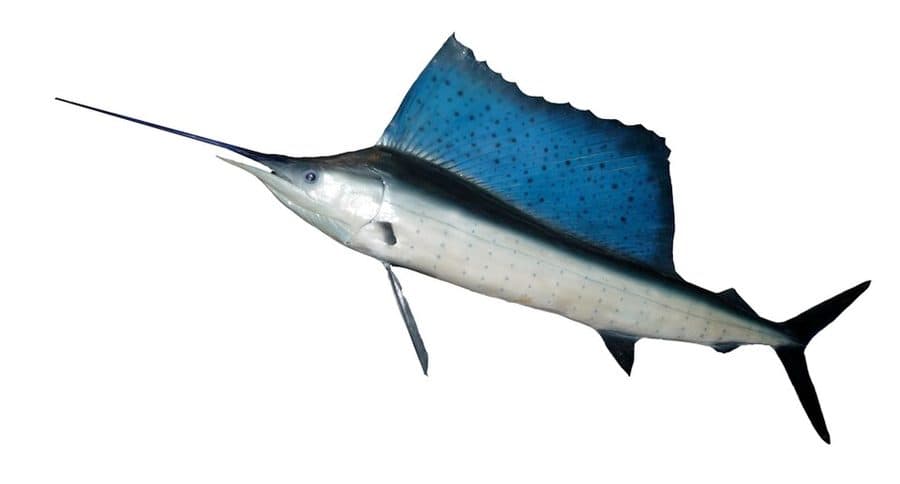
Sailfish
Istiophorus platypterus
The lit-up ballerina of the billfish — neon-flashing, sail flaring, greyhounding across the surface. South Florida's winter kite fishery made the Atlantic sail the world's most accessible billfish.
Live baits suspended from kites along the color change is the Florida method; circle hooks, quick releases, and light-tackle finesse define the modern ethic.
Quick Catch Plan
ID Characteristics
Use these field marks and context clues to separate sailfish from similar fish before logging or keeping one.
- Overall look: The lit-up ballerina of the billfish — neon-flashing, sail flaring, greyhounding across the surface. South Florida's winter kite fishery made the Atlantic sail the world's most accessible billfish.
- Typical size: 30–60 lb; trophy class: 80 lb+ (measured in releases, not pounds).
- Most likely setting: offshore in Florida, Gulf Coast, Atlantic Coast, Southeast.
- Where to confirm it: Free-jumpers, 'balling' sails corralling bait, frigates low and interested.
- Compared with White marlin: Sails have the huge sail dorsal; whites have a lower, rounded dorsal and rounded fin tips.
Gear Recommendations
- Rod
- 7' 20–30 lb class with soft tip
- Reel
- 20–30 conventional/8000 spinning, smooth light drags
- Main line
- 20–30 lb mono (stretch protects light pulls)
- Leader
- 50–60 lb fluorocarbon, 8–10 ft
- Hooks
- 6/0–8/0 non-offset circle (required for natural baits in billfish comps/federal rules)
- Jigheads
- n/a
- Terminal tackle
- Kite clips, balloons as poor-man's kites, rigging floss
- Lure sizes
- Bait-sized
- Lure colors
- n/a — the bait's panic is the color
- Baits
- Goggle-eyes (premium) · Threadfin herring · Pilchards · Ballyhoo
Winter charter out of Palm Beach/Keys — sailfishing is crew choreography; learn it live.
Balloon-suspended live threadfins along the edge from a capable outboard boat.
Double-kite spread with 6 baits, dredge teasers, release flags and a camera.
Techniques
- Presentation
- Kites hold baits splashing AT the surface — visible panic. Feed the fish on a free spool; count to 5; ease the drag up; wind tight. Never 'set' a circle.
- Retrieve
- The drop-back is everything with billfish; rush it and you pull the bait away.
- Positioning
- Bow into the wind/current holding station; the spread does the fishing.
- Depth
- Surface (kites) to 60 ft (deep bait).
- Structure
- Color changes, current edges, bait schools along the reef edge.
- Working current
- North current + north wind stacks sails riding the edge south — the FL winter pattern.
Kite fishing, slow-trolling lives, or trolling ballyhoo — all boat games.
Timing & Conditions
- Seasons
- FL: winter. Gulf/Carolinas: summer. Somebody's sailfishing all year.
- Time of day
- Mid-morning through afternoon works; light matters less than current/wind.
- Weather
- The counterintuitive one: sporty north-wind days after fronts are THE days in FL.
- Wind
- 15–20 kts north = kites flying and flags at the dock.
- Water temp
- 72–80°F edges.
- Tides
- Edge dynamics over tide per se.
- Moon
- Minor.
- Pressure
- Post-front = go (in FL winter).
- Seasonal movement
- Seasonal migrations along the Stream; tagged sails travel oceans.
Habitat — Where to Find Them
The edge: 90–300 ft where green meets blue, Stuart to Key West being the fabled lane; summer Gulf and Carolina fish too.
- Depth range
- Top 100 ft over the shelf edge.
- Look for
- Free-jumpers, 'balling' sails corralling bait, frigates low and interested.
- Migration
- Highly migratory; FL winter concentration is the accessible slice.
Common Mistakes
- Striking (setting) with circle hooks instead of easing tight
- Short drop-backs — feed them longer than feels right
- Heavy drags on light-wire mouths (pulled hooks)
- Dragging fish out of the water for photos — illegal for keeps and lethal for fish; leave them wet
- Ignoring the ugly-weather windows that ARE the bite
Catch, Handling & Release
- Landing
- Leader touch = official release. Bill-hold boatside only, fish in the water.
- Handling
- Support in water, moving boat slowly forward to revive — never haul aboard.
- Release
- The entire fishery is release; circle hooks + wet fish + quick photos.
- Conservation
- Federal HMS permit required; 63" LJFL minimum if (rarely) retained; circle hooks with natural baits; report landings — practically, release everything.
Common Lookalikes
Sails have the huge sail dorsal; whites have a lower, rounded dorsal and rounded fin tips.
Local Regulations
Size limits, bag limits, seasons, and gear rules change every year and differ by state (and often by individual water). Always verify with the official source before keeping fish.

All state sources for this species
Guide data is editorial and general — conditions, regulations, and fish behavior vary by water. Photo: Wikipedia — Atlantic sailfish.
