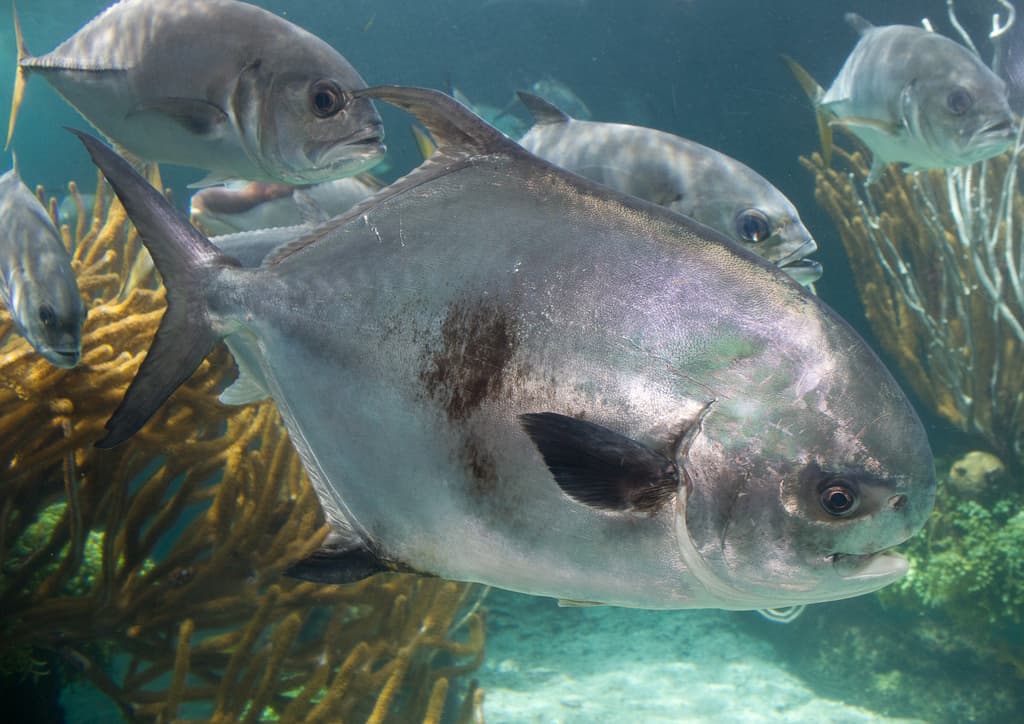
Permit
Trachinotus falcatus
The final boss of flats fishing — a big, dinner-plate jack with supernatural wariness and a taste for crabs. Fly anglers measure careers in permit; spin anglers with a live crab merely measure years.
A live crab presented quietly ahead of a tailing fish is the honest path; a crab fly eaten on a flat is the sport's grail. Wreck fish offer the 'easier' permit — still not easy.
Quick Catch Plan
ID Characteristics
Use these field marks and context clues to separate permit from similar fish before logging or keeping one.
- Overall look: The final boss of flats fishing — a big, dinner-plate jack with supernatural wariness and a taste for crabs. Fly anglers measure careers in permit; spin anglers with a live crab merely measure years.
- Typical size: 10–25 lb; trophy class: 30 lb+.
- Most likely setting: flats, inshore, reef, wreck in Florida.
- Where to confirm it: Black sickle tails and fins waving over shallow grass; big pushes of nervous water.
- Compared with Florida pompano: Pompano stay small (rarely 6 lb+); permit are deeper-bodied with a taller sickle dorsal and larger eye.
Gear Recommendations
- Rod
- 7'6" M-MH fast spinning (or 9–10 wt fly)
- Reel
- 4000–5000, silky drag, 200+ yds capacity
- Main line
- 15–20 lb braid
- Leader
- 25–30 lb fluorocarbon, 4–5 ft
- Hooks
- 1/0–2/0 strong short-shank (crab through the point of the shell)
- Jigheads
- 3/8 oz skimmers; 1.5–3 oz for wrecks
- Terminal tackle
- Minimal — stealth rules the flats
- Lure sizes
- 2–3" crabs; flies #2–1/0
- Lure colors
- Tan, olive, root beer — crab colors
- Baits
- Live crabs (the permit key) · Live shrimp (they'll deign occasionally)
Honestly: a guide, a spinning rod, and live crabs. Permit are not a solo starter species.
DIY: kayak the Keys backcountry with crabs and grind the flood tides.
The full program: poling skiff, 10-wt with crab flies, tide calendar built around March–June, wreck jigging as the confidence backup.
Techniques
- Presentation
- Lead tailing fish by 6–10 ft, let the crab sink naturally — permit eat on the drop or follow it to bottom. Then do nothing until the line moves.
- Retrieve
- Almost none; a crab that flees looks wrong. Wrecks: heavy jig dropped through the school, ripped up.
- Positioning
- Down-tide approach, long casts (60+ ft), and silence — permit hear a pushpole scrape at absurd range.
- Depth
- 1–4 ft flats; 60–120 ft wrecks.
- Structure
- Flat edges, sandy pockets in turtle grass, channels; offshore wrecks and towers.
- Working current
- Flood tides bring them shallow to hunt crabs; time everything to it.
Poling skiff on flats; anchored/drifting jig sessions on wrecks.
Quiet, low, effective for DIY — cover flats edges on flood.
Timing & Conditions
- Seasons
- Spring flats run (Mar–Jun) is prime; wrecks in summer; fall reprise; deep-cold winter sends them off flats.
- Time of day
- Mid-morning to afternoon for light; the tide is the real clock.
- Weather
- Sun for sighting, under 15 kts wind, warm and stable.
- Wind
- The daily question — plan flats by the lee.
- Water temp
- 72–86°F flats window.
- Tides
- Flood tide is permit tide.
- Moon
- Spring tides push fish farther onto flats; big moons drive wreck spawning aggregations.
- Pressure
- Fronts clear the flats for days.
- Seasonal movement
- Flats-to-wreck seasonal rhythm; spawning offshore aggregations in summer.
Habitat — Where to Find Them
Florida Keys, Biscayne, and Southwest FL flats and channels; Gulf wrecks. Marginal sightings north of there.
- Depth range
- 1–4 ft (flats); 40–130 ft (wrecks).
- Look for
- Black sickle tails and fins waving over shallow grass; big pushes of nervous water.
- Migration
- Inshore-offshore spawning cycle; flats fidelity otherwise.
Common Mistakes
- Casting too close — lead them by a truck length
- Moving the crab when the fish approaches (statues win)
- Weak hooks that open on the first run to the channel
- Skipping the tide plan and 'just going fishing'
- Counting follows as progress (permit will break your heart; this is normal)
Catch, Handling & Release
- Landing
- Net; long fights around flats edges and channel drops.
- Handling
- Big fish, full horizontal support, quick photos.
- Release
- Standard practice and required in Special Permit Zones; revive completely — sharks know the game.
- Conservation
- FL Special Permit Zone (Keys) is catch-and-release focused with strict rules; check current FWC regs.
Common Lookalikes
Pompano stay small (rarely 6 lb+); permit are deeper-bodied with a taller sickle dorsal and larger eye.
Local Regulations
Size limits, bag limits, seasons, and gear rules change every year and differ by state (and often by individual water). Always verify with the official source before keeping fish.
All state sources for this species
Guide data is editorial and general — conditions, regulations, and fish behavior vary by water. Photo: Wikipedia — Permit (fish).
