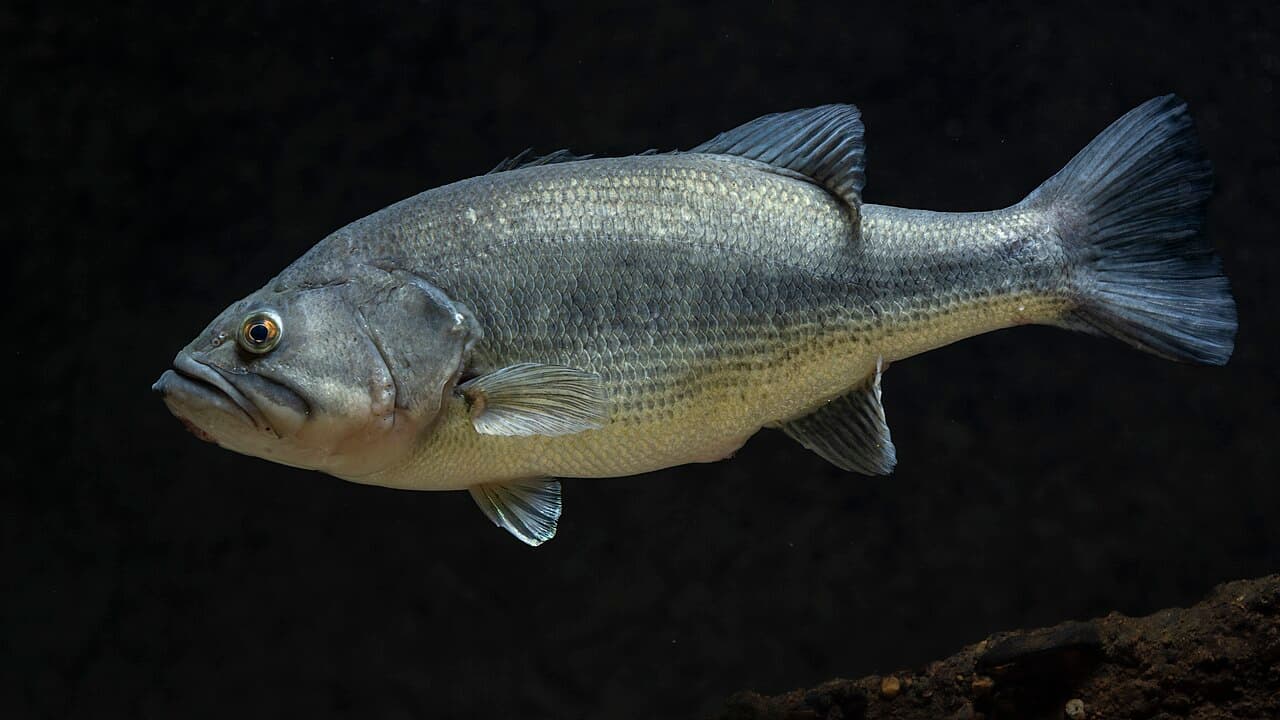
Largemouth Bass
Micropterus salmoides
America's most popular gamefish. An ambush predator that holds tight to cover — grass, wood, docks — and eats almost anything that fits in its oversized mouth.
Find cover, put a natural-looking bait next to it, and be ready. Largemouth relate to structure almost all year, which makes them the best fish in America to learn pattern fishing on.
Quick Catch Plan
ID Characteristics
Use these field marks and context clues to separate largemouth bass from similar fish before logging or keeping one.
- Overall look: America's most popular gamefish. An ambush predator that holds tight to cover — grass, wood, docks — and eats almost anything that fits in its oversized mouth.
- Typical size: 1–4 lb; trophy class: 8 lb+ (double digits in FL, TX, CA).
- Most likely setting: lake, pond, river, canal, dock in Nationwide.
- Where to confirm it: The edge where two things meet: grass to open water, shade to sun, shallow to deep, wood to rock.
- Compared with Smallmouth bass: A largemouth's jaw extends past the back of the eye and it has a dark horizontal stripe; smallmouth are bronze with vertical bars and a shorter jaw.
- Compared with Spotted bass: Spotted bass have a rough tongue patch, rows of dark spots below the lateral line, and the jaw does not extend past the eye.
Gear Recommendations
- Rod
- 6'10"–7'3" medium-heavy, fast action
- Reel
- 3000-size spinning or 7.1:1 baitcaster
- Main line
- 15–30 lb braid or 12–15 lb fluorocarbon
- Leader
- 12–15 lb fluorocarbon when using braid
- Hooks
- 3/0–4/0 EWG worm hooks, 1/0 for smaller plastics
- Jigheads
- 1/8–1/4 oz shaky heads and swimbait heads
- Terminal tackle
- Bullet weights 1/8–3/8 oz, bobber stops, 3/8–1/2 oz jigs
- Lure sizes
- 4–6" worms, 1/2 oz spinnerbaits, 2.5 squarebills
- Lure colors
- Clear water: green pumpkin, watermelon, natural shad. Stained: black/blue, chartreuse, white
- Baits
- Live shiners · Nightcrawlers · Creek minnows
6'6" medium spinning combo, 10 lb mono, bag of 5" stick worms and 3/0 worm hooks — rig weightless and twitch it near cover.
7' MH combo (~$60), 15 lb braid, small box: stick worms, 1/2 oz spinnerbait, squarebill, 3/8 oz jig.
Dedicated rods: 7'3" MH casting for jigs/Texas rigs, 6'10" M for treble baits, 7' M spinning for finesse; quality baitcaster, fluoro for bottom contact, braid-to-leader for finesse.
Techniques
- Presentation
- Cast past the target and bring the bait to the cover. Let soft plastics fall on slack line — most bites come on the initial fall.
- Retrieve
- Slow with bottom contact for plastics and jigs; steady with occasional rips for moving baits. Let the fish tell you the speed.
- Positioning
- Approach quietly, cast up-shade and up-wind. Work parallel to grass edges and bank cover instead of perpendicular.
- Depth
- 0–8 ft most of the year; 10–20 ft in mid-summer and winter.
- Structure
- Docks, laydowns, grass lines, lily pads, riprap, brush piles, creek channel bends, points.
- Working current
- In rivers, fish current seams and eddies behind wood and behind bridge pilings.
Keep the boat off the cover line and make long casts; use the trolling motor, not the outboard, inside 100 yards.
Your stealth is an advantage — get tight to cover other anglers can't reach and skip baits under docks.
Fish parallel to the bank first — most pond bass sit within 10 ft of shore. Work the whole bank fan-casting before moving.
Timing & Conditions
- Seasons
- Pre-spawn (water 55–65°F) is the best big-fish window of the year. Fall shad migration is the numbers game. Fishable all 12 months in the South.
- Time of day
- Dawn and dusk in warm months; mid-day sun pushes fish tight to shade and cover.
- Weather
- Overcast with light wind is prime. A warm front in spring turns fish on.
- Wind
- A light chop helps moving baits; fish the wind-blown bank where bait stacks up.
- Water temp
- Active 55–85°F, ideal 65–75°F. Below 50°F slow way down.
- Moon
- Full and new moon periods intensify the spawn in spring.
- Pressure
- Falling pressure ahead of a front is often the best bite of the week; post-front bluebird skies are the toughest.
- Seasonal movement
- Winter deep → pre-spawn staging on points → spawn in protected shallows → summer shade/deep grass → fall creeks chasing shad → back deep.
Habitat — Where to Find Them
Warm, slow water with cover. Farm ponds, reservoir coves, natural lakes, backwaters of rivers, and canals all hold largemouth.
- Depth range
- 1–20 ft; the bulk of catchable fish live shallower than 10 ft.
- Look for
- The edge where two things meet: grass to open water, shade to sun, shallow to deep, wood to rock.
- Migration
- Seasonal, short-range: deep wintering holes to shallow spawning bays and back — follow the creek channels.
Common Mistakes
- Fishing too fast — a stick worm needs 10+ seconds of free fall near cover
- Casting to open water instead of to targets
- Setting the hook the instant you feel a tap on plastics — reel down, feel weight, then sweep
- Line too heavy and visible in clear water, or too light around thick grass
- Ignoring the shallowest water at dawn
- Skipping the follow-up cast — bass often miss and eat the next one
Catch, Handling & Release
- Landing
- Lip-land with a firm thumb grip; support the belly on fish over 3 lb — never hold big bass horizontally by the jaw alone.
- Handling
- Wet hands, minimal air time, no fingers in the gills.
- Release
- Most bass anglers release everything; ease tired fish back upright until they kick off.
- Conservation
- Nearly every state has bass length and creel limits, and many lakes have slot limits — check your state agency page before keeping fish.
Common Lookalikes
A largemouth's jaw extends past the back of the eye and it has a dark horizontal stripe; smallmouth are bronze with vertical bars and a shorter jaw.
Spotted bass have a rough tongue patch, rows of dark spots below the lateral line, and the jaw does not extend past the eye.
Local Regulations
Size limits, bag limits, seasons, and gear rules change every year and differ by state (and often by individual water). Always verify with the official source before keeping fish.

All state sources for this species
Guide data is editorial and general — conditions, regulations, and fish behavior vary by water. Photo: Wikipedia — Largemouth bass.
