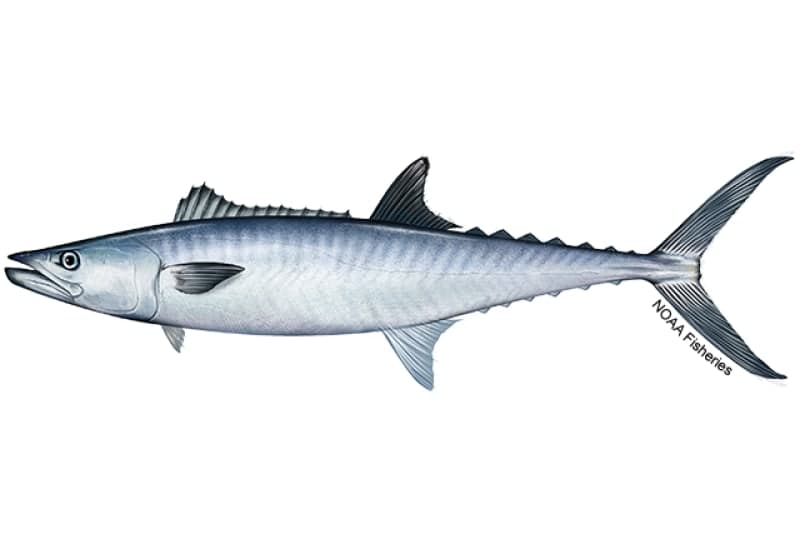
King Mackerel
SaltwaterIn season now

King Mackerel

Scomberomorus cavalla

The smoker king — a 5-foot torpedo whose first run melts drags and whose sky-high 'skyrocket' strikes on live bait are one of saltwater's great sights. Pier legends are built on kings.

Typical size
8–20 lb
Trophy class
40 lb+ ('smokers')
Moderate

Slow-troll live baits on wire stinger rigs along color changes, bait schools, and reefs. On piers, a live bluefish or runner under a float off the end does the same job — then hold on.

Quick Catch Plan

Best bait right now
Live menhaden (pogy) slow-trolled on a two-hook wire stinger rig
Recommended lure
Drone spoons behind planers, dusters with ribbonfish, big swimming plugs
Setup
7' medium-light 'live bait' rod, 6000 spinning or 20-size conventional, 20 lb mono or 30 lb braid, #4 wire stinger
Where to go
Nearshore reefs, color changes, bait pods 1–10 miles off; pier ends
Best time
Dawn through mid-morning; moving tide at piers
Season notes
Spring and fall runs are peak on most coasts; summer holds fish on deeper structure.

ID Characteristics

Use these field marks and context clues to separate king mackerel from similar fish before logging or keeping one.

  • Overall look: The smoker king — a 5-foot torpedo whose first run melts drags and whose sky-high 'skyrocket' strikes on live bait are one of saltwater's great sights. Pier legends are built on kings.
  • Typical size: 8–20 lb; trophy class: 40 lb+ ('smokers').
  • Most likely setting: nearshore, pier, offshore, reef, wreck in Gulf Coast, Atlantic Coast, Southeast, Florida.
  • Where to confirm it: Bait balls with birds; skyrocketing fish clearing the water through schools.
  • Compared with Spanish mackerel: Kings lose their spots with age, lack the black dorsal flag, and the lateral line dips sharply mid-body.

Gear Recommendations

Rod
6'6"–7'6" ML-M with soft tip (live bait) and strong mid-section
Reel
6000–8000 spinning or 20–30 class conventional, high capacity
Main line
20 lb mono (stretch is a friend) or 30–40 lb braid
Leader
3–4 ft of #4–#6 single-strand wire (kings bite through everything else)
Hooks
1/0 live-bait nose hook + #4 treble stinger on wire
Terminal tackle
Small black swivels, haywire twists (learn this knot/twist)
Lure sizes
Spoons 3.5–5", plugs 6–8"
Lure colors
Silver, pink/white dusters, green/chrome
Baits
Live menhaden · Live blue runners ('hardtails') · Live mullet · Frozen ribbonfish (trolled)
Beginner setup

Pier: heavy spinning combo, wire stinger rig, live bluefish/runner under a balloon float off the end — the traditional apprenticeship.

Budget setup

Small-boat: two rods slow-trolling pogies along the beach — deadly simple.

Serious angler

Full king rig: livewell + sabiki bait program, downrigger or planer spread, drag-tuned reels, tournament-style stinger boxes.

Techniques

Presentation
Slow-troll (1–2 kts) live baits so they swim naturally; stagger depths — one flat-lined, one down.
Retrieve
None on strike — let the skyrocket happen, keep the drag smooth (5–7 lb), and DON'T grab the spool.
Positioning
Work color changes, tide lines, and bait pods in S-curves; the outside bait speeds up on turns.
Depth
20–80 ft of water; baits in the top 30 ft.
Structure
Reefs, wrecks, tide lines, bait schools, pier ends.
Working current
Clean moving green-blue water carries the bait highway.
boat fishing

The main method: livewell, wire rigs, patience at trolling speed.

pier fishing

The 'king rig' tradition: anchor rod + slide-down bait; landing via pier net or walking fish to the beach.

kayak fishing

Growing sport: slow-troll a runner offshore of the breakers — the sleigh ride is real.

Timing & Conditions

Seasons
Spring (Apr–Jun) and fall (Sep–Nov) runs; summer resident fish on structure.
Time of day
Dawn bite is best; overcast extends it.
Weather
1–3 ft seas and clean water; kings vanish in mud.
Wind
Offshore-friendly forecasts only; this is open-water fishing.
Water temp
68–82°F, sweet spot ~72–76°F.
Tides
Pier bite keys on moving tide; open water keys on bait presence.
Moon
Live-baiters favor moon-tide bait movements; minor overall.
Pressure
Stable to falling; feeding often spikes pre-front.
Seasonal movement
Long coastal migrations both coasts; year-round fish in S. FL.

Habitat — Where to Find Them

Nearshore shelf waters of the entire Southeast/Gulf; within casting range of long piers on good days.

Depth range
20–150 ft of water, feeding shallow in the column.
Look for
Bait balls with birds; skyrocketing fish clearing the water through schools.
Migration
Two annual passes along most of the coast (spring north, fall south in general terms).
reefswreckscolor changesbait podspier ends

Common Mistakes

  • Mono/fluoro-only leaders (instant cutoff)
  • Locked-down drags — kings need to run or they pull hooks/break off
  • Trolling too fast for live bait
  • One-hook rigs (kings slash baits in half behind a single hook — the stinger catches them)
  • Gaffing green fish boatside — the last run happens AT the boat

Catch, Handling & Release

Landing
Gaff keepers cleanly behind the head; pier fish need drop nets.
Handling
Teeth demand full respect — control the head, pliers only.
Release
Support horizontally, avoid the teeth, swim them off; they recover if fought efficiently.
Conservation
24" fork minimum typical, 2–3/day depending on state/federal zone — verify current rules.

Common Lookalikes

Spanish mackerel

Kings lose their spots with age, lack the black dorsal flag, and the lateral line dips sharply mid-body.

Guide data is editorial and general — conditions, regulations, and fish behavior vary by water. Photo: Wikipedia — King mackerel.