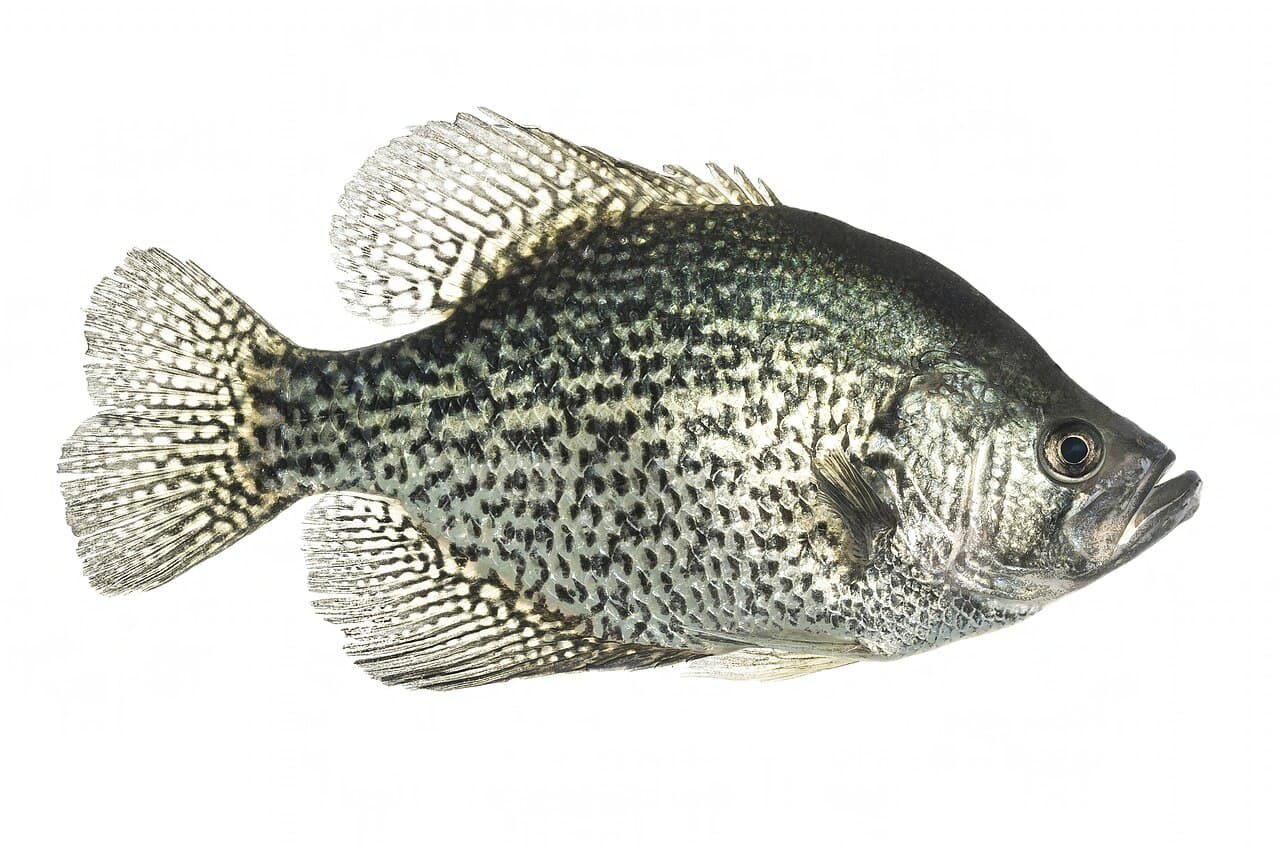
Crappie
Pomoxis nigromaculatus / annularis
The best-eating panfish in America. Black and white crappie school around brush and bridges, and when you find one you've usually found fifty.
Vertical fishing around cover. A minnow or 1/16 oz jig at the right depth next to brush, bridge pilings, or dock posts is 90% of crappie fishing.
Quick Catch Plan
ID Characteristics
Use these field marks and context clues to separate crappie from similar fish before logging or keeping one.
- Overall look: The best-eating panfish in America. Black and white crappie school around brush and bridges, and when you find one you've usually found fifty.
- Typical size: 0.5–1 lb; trophy class: 2 lb+ ('slabs').
- Most likely setting: lake, pond, river, dock, bridge in Nationwide.
- Where to confirm it: Wood + depth change. A brush pile on a channel edge is the classic year-round spot.
- Compared with White crappie vs black crappie: White crappie have 5–6 dorsal spines and vertical bars; black crappie have 7–8 spines and speckles.
- Compared with Bluegill: Bluegill are deeper-bodied with a small mouth; crappie have a large, paper-thin mouth.
Gear Recommendations
- Rod
- 6'6" light spinning, or 10–12' jig pole for dipping cover
- Reel
- 1000–2000 spinning
- Main line
- 4–6 lb hi-vis mono or 10 lb braid to light leader
- Leader
- 4–6 lb mono/fluoro
- Hooks
- #2–#4 light-wire Aberdeen (bend free from snags)
- Jigheads
- 1/32–1/8 oz, 1/16 oz the workhorse
- Terminal tackle
- Slip floats, bobber stops, tiny split shot
- Lure sizes
- 1–2" tubes and curly tails
- Lure colors
- Chartreuse, pink/white, monkey milk, black/chartreuse in stained water
- Baits
- Live minnows (the crappie staple) · Crappie nibbles on jigs · Waxworms through the ice
Any light spinning combo, slip float, #2 hook, bucket of minnows — set depth to just above the brush.
6'6" light combo + assortment of 1/16 oz jigs (~$40 total).
Livescope-style sonar and long jig poles for precision dipping; multiple pre-tied jig rods.
Techniques
- Presentation
- Get the bait to the fish's depth — crappie feed upward, so keep it slightly above them, and hold it still.
- Retrieve
- Barely any: slow lift-drop, or dead-still under a float. If jigging, a slow steady swim past cover.
- Positioning
- Directly over cover when possible; from shore, fan casts with a float rig around visible wood.
- Depth
- 1–5 ft spawning; 8–20 ft rest of year, suspended near cover.
- Structure
- Brush piles, stake beds, bridge pilings, dock posts, standing timber, channel edges.
- Working current
- In rivers, backwaters and marina basins out of current.
Spider-rigging or single-pole dipping over marked brush; hover with the trolling motor.
Lighted docks at night are crappie magnets — fish the shadow edge of the lights.
Quietly hold over timber with a jig pole — deadly.
Bridges, fishing piers, and marinas put shore anglers on deep cover — bring the slip float.
Timing & Conditions
- Seasons
- Spring spawn is the peak; late fall stacks them on deep brush; ice fishing is excellent in the North.
- Time of day
- All day; night under lights in summer.
- Weather
- Stable warm spells in spring; overcast helps shallow bites.
- Wind
- Protected water fishes better — crappie dislike heavy chop shallow.
- Water temp
- Spawn 58–68°F; suspend deep above/below 75°F.
- Moon
- Some of the best spawns concentrate around the full moons of March–May.
- Seasonal movement
- Deep winter holes → staging on channel edges → shallow spawn → summer suspension → fall regroup on brush.
Habitat — Where to Find Them
Reservoirs, natural lakes, ponds, and slow rivers nationwide — anywhere with woody cover and minnows.
- Depth range
- 1–25 ft by season; suspended fish sit at a precise depth band.
- Look for
- Wood + depth change. A brush pile on a channel edge is the classic year-round spot.
- Migration
- Short seasonal moves along creek channels between deep water and spawning banks.
Common Mistakes
- Fishing below the school — crappie eat up, not down
- Heavy hooksets that tear the paper mouth — a smooth lift is plenty
- Line too heavy; 6 lb max in clear water
- Moving too fast between spots — work brush from all angles first
- Skipping depth changes of even 1 ft on tough days
Catch, Handling & Release
- Landing
- Swing small fish; net slabs — the thin mouth tissue tears.
- Handling
- Easy to hold by the lower lip; mind the dorsal spines.
- Release
- Keep a legal mess to eat (they're prolific); release the big breeders during spawn.
- Conservation
- Most states set creel limits (often 15–30) and some lakes have 9–10" minimums.
Common Lookalikes
White crappie have 5–6 dorsal spines and vertical bars; black crappie have 7–8 spines and speckles.
Bluegill are deeper-bodied with a small mouth; crappie have a large, paper-thin mouth.
Local Regulations
Size limits, bag limits, seasons, and gear rules change every year and differ by state (and often by individual water). Always verify with the official source before keeping fish.

All state sources for this species
Guide data is editorial and general — conditions, regulations, and fish behavior vary by water. Photo: Wikipedia — Black crappie.
