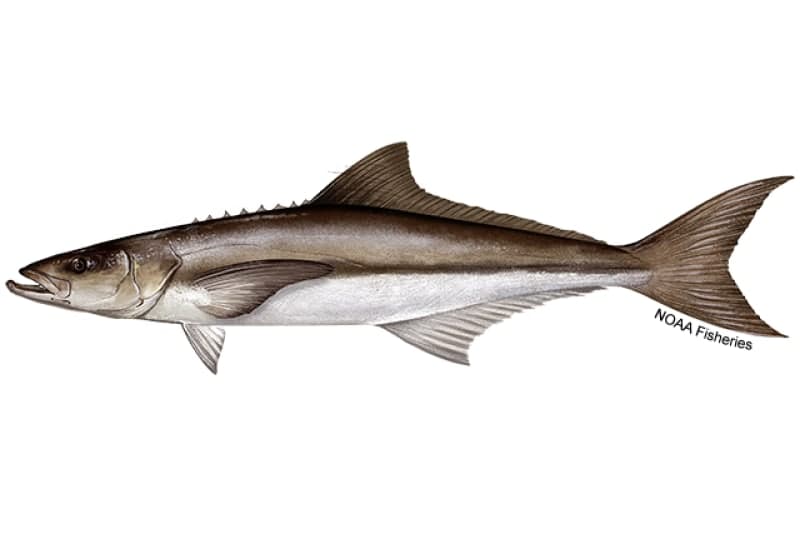
Cobia
Rachycentron canadum
The curious brown bruiser that swims up to boats, follows rays and turtles, and fights like a dirty street brawler all the way to the fish box — where it earns its reputation twice: chaos, then steaks.
A sight-fishing scavenger hunt: scan for brown shapes around buoys, rays, turtles, and bait pods, then feed the fish a jig or eel before it loses interest. Always have a rod rigged.
Quick Catch Plan
ID Characteristics
Use these field marks and context clues to separate cobia from similar fish before logging or keeping one.
- Overall look: The curious brown bruiser that swims up to boats, follows rays and turtles, and fights like a dirty street brawler all the way to the fish box — where it earns its reputation twice: chaos, then steaks.
- Typical size: 15–30 lb; trophy class: 60 lb+.
- Most likely setting: nearshore, inshore, pier, wreck, reef in Gulf Coast, Atlantic Coast, Southeast, Florida.
- Where to confirm it: Brown torpedo shapes with a sidekick posture near anything notable in the water.
- Compared with Remora/sharksucker: The eternal cobia prank — remoras have the suction disc on the head. Look before you cast (and before you gaff).
- Compared with Small shark: From above, cobia's broad flat head and brown color read 'shark' until the pectoral posture and tail give it away.
Gear Recommendations
- Rod
- 7'–8' MH-H fast spinning
- Reel
- 6000–8000
- Main line
- 40–50 lb braid
- Leader
- 50–60 lb fluorocarbon, 3 ft
- Hooks
- 7/0–9/0 circle for live baits/eels
- Jigheads
- 2–4 oz bucktails
- Terminal tackle
- Direct ties; keep it simple and strong
- Lure sizes
- 6–10"
- Lure colors
- Chartreuse (the cobia color), orange, dark eel tones
- Baits
- Live eels (candy) · Live pinfish/croakers · Blue crabs · Big live shrimp
One heavy spinning rod rigged with a bucktail, kept ready while doing anything else nearshore — cobia are an opportunity, take it.
Add a dozen frozen-then-livened eels in the livewell during the run.
Tower boat scanning the beach lanes in spring, dual rigged rods (jig + eel), a second angler as dedicated spotter.
Techniques
- Presentation
- Lead the fish slightly, land the jig in its window, and hop it away — fleeing prey flips their switch. If refused, change baits fast; a second offering often eats.
- Retrieve
- Aggressive hops; eels need only be near the fish.
- Positioning
- Approach sighted fish from up-sun, cut the motor early, cast before the boat is noticed.
- Depth
- Surface sight-fishing mostly; wrecks 30–100 ft.
- Structure
- Buoys, markers, wrecks, ray/turtle escorts, bait pods, pier pilings.
- Working current
- Structure fish face current; sight fish just cruise — deal with the fish in front of you.
The sight-fishing run along beaches; jigging wrecks blind on the drop.
Spring pier tradition: heavy jig or live eel pitched to cruisers.
Rare but real during runs — heavy jig on standby.
Wrecks and markers within paddle range; be ready for a towing fight.
Timing & Conditions
- Seasons
- Spring run is the event; summer wreck fish; they winter south/offshore.
- Time of day
- 10 a.m.–4 p.m. sun for spotting.
- Weather
- Bright sun, light wind, clean water — sight-fishing weather.
- Wind
- Under 10–12 kts to see them.
- Water temp
- 68–84°F; the run rides the 68–72° line north.
- Tides
- Secondary; bait and light matter more.
- Pressure
- Stable sunny stretches are the run windows.
- Seasonal movement
- Well-defined temperature-driven coastal migration each spring/fall.
Habitat — Where to Find Them
Nearshore waters of the Gulf and Southeast Atlantic; anything floating or swimming big may have a cobia under it.
- Depth range
- Surface to 100 ft.
- Look for
- Brown torpedo shapes with a sidekick posture near anything notable in the water.
- Migration
- Spring north/inshore, fall south/offshore — timed by water temp.
Common Mistakes
- No rod rigged when the fish appears (the classic regret)
- Casting on the fish's head and spooking it
- Gaffing a green cobia — they demolish boats; tire them fully
- Assuming every brown fish is a shark or remora
- Undersized fish kept — the size limit is high and enforced
Catch, Handling & Release
- Landing
- Gaff only when clearly whipped, straight into the box and shut the lid (seriously). Or net-and-release with control.
- Handling
- Powerful and violent boatside — control the head, no loose ends.
- Release
- Sturdy fish; revive and release cleanly.
- Conservation
- High minimums (33–36"+ fork, varies) and tight bags (often 1/person, 2/boat) — current rules matter.
Common Lookalikes
The eternal cobia prank — remoras have the suction disc on the head. Look before you cast (and before you gaff).
From above, cobia's broad flat head and brown color read 'shark' until the pectoral posture and tail give it away.
Local Regulations
Size limits, bag limits, seasons, and gear rules change every year and differ by state (and often by individual water). Always verify with the official source before keeping fish.
All state sources for this species
Guide data is editorial and general — conditions, regulations, and fish behavior vary by water. Photo: Wikipedia — Cobia.
