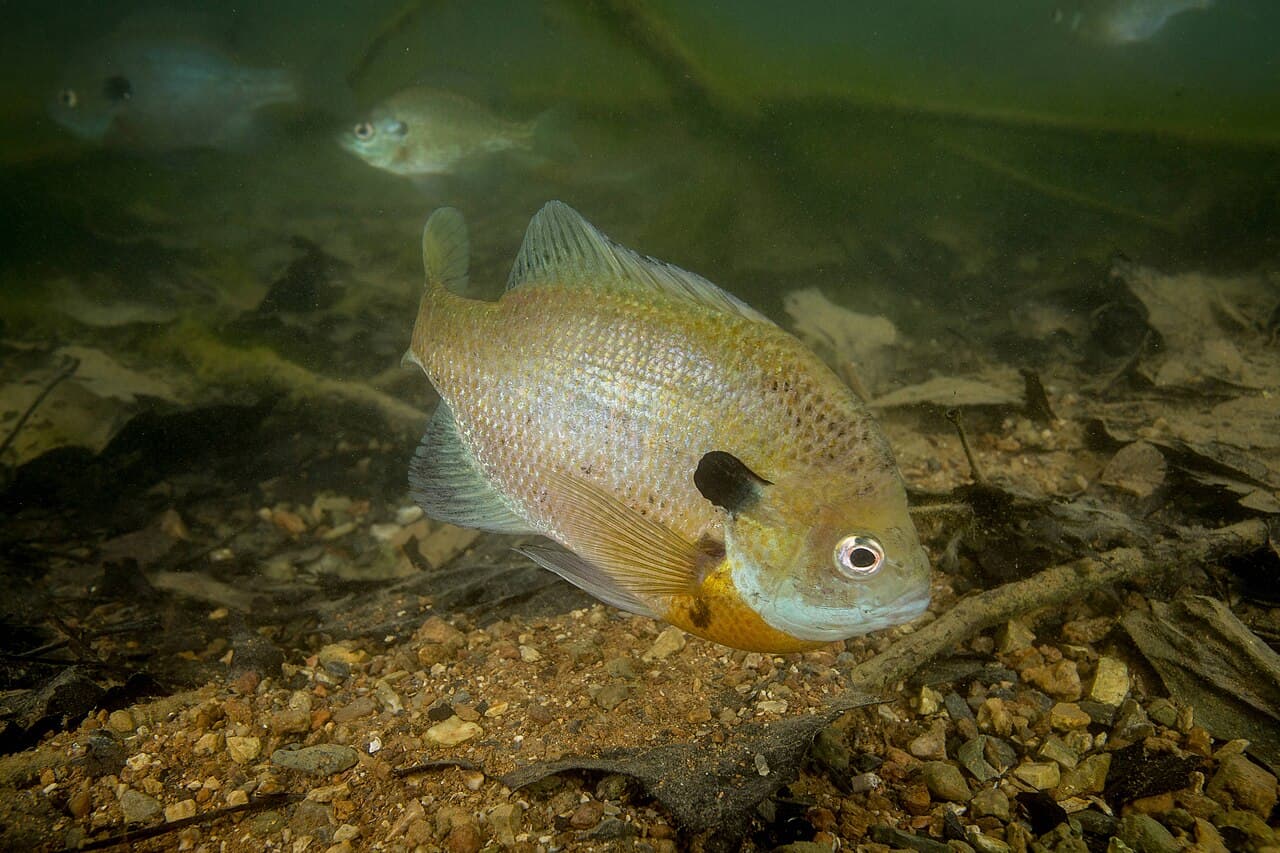
Bluegill
FreshwaterBeginner friendlyIn season now

Bluegill

Lepomis macrochirus

The fish most Americans catch first — aggressive, everywhere, and a scrappy fighter on light tackle. Big 'bull' bluegill are a legitimate trophy pursuit.

Typical size
4–8 in
Trophy class
10 in+ / 1 lb+
Easy

A piece of worm under a small float near cover catches bluegill nearly anywhere, all season. Targeting true bulls means fishing deeper weed edges with finesse baits.

Quick Catch Plan

Best bait right now
Half a nightcrawler or a cricket under a pencil float, #8 hook
Recommended lure
1/32 oz jig with a 1" plastic, or a small popper on a fly rod
Setup
5'6"–7' ultralight spinning, 1000 reel, 4 lb mono
Where to go
Pond edges, dock shade, weed lines
Best time
Anytime; late afternoon is prime in summer
Season notes
Spawn (May–June most places, water 68–75°F) fills shallow bowls with visible beds — sight-fish them.

ID Characteristics

Use these field marks and context clues to separate bluegill from similar fish before logging or keeping one.

  • Overall look: The fish most Americans catch first — aggressive, everywhere, and a scrappy fighter on light tackle. Big 'bull' bluegill are a legitimate trophy pursuit.
  • Typical size: 4–8 in; trophy class: 10 in+ / 1 lb+.
  • Most likely setting: pond, lake, river, creek, dock in Nationwide.
  • Where to confirm it: Elodea/coontail edges and shade. Spawning colonies look like honeycomb craters in the shallows.
  • Compared with Redear sunfish: Redears have a red/orange edge on the ear flap; bluegill's flap is solid black.
  • Compared with Green sunfish: Green sunfish have a much bigger mouth and turquoise facial streaks.

Gear Recommendations

Rod
Ultralight spinning 5'–7', or a simple cane/telescopic pole
Reel
500–1000 spinning
Main line
2–4 lb mono
Leader
None needed
Hooks
#6–#10 long-shank (easier to unhook deep swallows)
Jigheads
1/64–1/32 oz
Terminal tackle
Pinch-on split shot, small pencil or ball floats
Lure sizes
1–1.5" plastics, size 10 poppers
Lure colors
Black, white, chartreuse — color matters less than size
Baits
Red worms/nightcrawler pieces · Crickets · Waxworms · Bread balls in a pinch
Beginner setup

Any ultralight combo or pole + float + split shot + #8 hook + worms. Total cost under $25.

Budget setup

Same, plus a small box of 1/32 oz jigs for casting.

Serious angler

3-wt fly rod with small poppers and nymphs, or long UL rods with 2 lb line for deep bulls.

Techniques

Presentation
Suspend bait 1–3 ft under a float near cover. Let it sit; twitch occasionally.
Retrieve
Slow, tiny hops for jigs. Poppers: pop, wait, pop.
Positioning
Approach beds and shorelines quietly — bluegill spook shallow.
Depth
1–4 ft spring/summer; 6–15 ft weed edges for big ones and in winter.
Structure
Docks, weed edges, laydowns, overhanging trees, riprap.
pier fishing

Fish straight down the pilings; bluegill hold on the shady side.

kayak fishing

Cruise weed lines and drop a jig along the edge.

shore fishing

Every pond bank in America. Fish shade lines and any structure within casting range.

Timing & Conditions

Seasons
Spring through fall shallow; late-spring spawn is the classic peak. Great first ice target too.
Time of day
All day; big bulls feed best early and late.
Weather
Sunny warm afternoons are fine — bluegill are the exception to the clouds rule.
Wind
Calm banks are easier with light floats.
Water temp
Active 60–85°F; spawn ~70°F.
Moon
Full moons of May–August trigger repeat spawning waves in the South.
Seasonal movement
Shallow all warm season; slide to deeper weed edges in heat and winter.

Habitat — Where to Find Them

Ponds, lakes, creeks, canals, slow rivers — if it holds water in the lower 48, it may hold bluegill.

Depth range
1–15 ft.
Look for
Elodea/coontail edges and shade. Spawning colonies look like honeycomb craters in the shallows.
weed edgesdocksbrushoverhangsspawning bowls on sand/gravel

Common Mistakes

  • Hooks too big — a bluegill mouth is dime-sized; use #8 or smaller
  • Too much bait on the hook, letting them steal it
  • Setting the float too deep and fishing under the fish
  • Ignoring deeper edges when only small ones bite shallow — bulls hold deeper
  • Heavy line that kills the float action

Catch, Handling & Release

Landing
Swing them in; smooth the dorsal spines back as you grip.
Handling
Flatten the spines with your palm sliding front-to-back.
Release
Selective harvest is healthy: keep medium eaters, release the biggest bulls to spawn.
Conservation
Generous limits in most states, but some trophy lakes restrict harvest of big sunfish.

Common Lookalikes

Redear sunfish

Redears have a red/orange edge on the ear flap; bluegill's flap is solid black.

Green sunfish

Green sunfish have a much bigger mouth and turquoise facial streaks.

Local Regulations

Size limits, bag limits, seasons, and gear rules change every year and differ by state (and often by individual water). Always verify with the official source before keeping fish.
All state sources for this species
ALAlabama Dept. of Conservation & Natural ResourcesAKAlaska Dept. of Fish & GameAZArizona Game & Fish Dept.ARArkansas Game & Fish CommissionCACalifornia Dept. of Fish & WildlifeCOColorado Parks & WildlifeCTConnecticut DEEPDEDelaware Div. of Fish & WildlifeFLFlorida Fish & Wildlife Conservation Commission (FWC)GAGeorgia Dept. of Natural ResourcesHIHawaii Div. of Aquatic ResourcesIDIdaho Fish & GameILIllinois Dept. of Natural ResourcesINIndiana Dept. of Natural ResourcesIAIowa Dept. of Natural ResourcesKSKansas Dept. of Wildlife & ParksKYKentucky Dept. of Fish & WildlifeLALouisiana Dept. of Wildlife & FisheriesMEMaine Dept. of Inland Fisheries & WildlifeMDMaryland Dept. of Natural ResourcesMAMassWildlife / Div. of Marine FisheriesMIMichigan Dept. of Natural ResourcesMNMinnesota Dept. of Natural ResourcesMSMississippi Dept. of Wildlife, Fisheries & ParksMOMissouri Dept. of ConservationMTMontana Fish, Wildlife & ParksNENebraska Game & ParksNVNevada Dept. of WildlifeNHNew Hampshire Fish & GameNJNew Jersey Div. of Fish & WildlifeNMNew Mexico Dept. of Game & FishNYNew York Dept. of Environmental ConservationNCNC Wildlife Resources Commission / Div. of Marine FisheriesNDNorth Dakota Game & FishOHOhio Dept. of Natural ResourcesOKOklahoma Dept. of Wildlife ConservationOROregon Dept. of Fish & WildlifePAPennsylvania Fish & Boat CommissionRIRhode Island DEMSCSouth Carolina Dept. of Natural ResourcesSDSouth Dakota Game, Fish & ParksTNTennessee Wildlife Resources AgencyTXTexas Parks & Wildlife Dept.UTUtah Div. of Wildlife ResourcesVTVermont Fish & WildlifeVAVirginia DWR / Marine Resources CommissionWAWashington Dept. of Fish & WildlifeWVWest Virginia Div. of Natural ResourcesWIWisconsin Dept. of Natural ResourcesWYWyoming Game & Fish Dept.

Guide data is editorial and general — conditions, regulations, and fish behavior vary by water. Photo: Wikipedia — Bluegill.