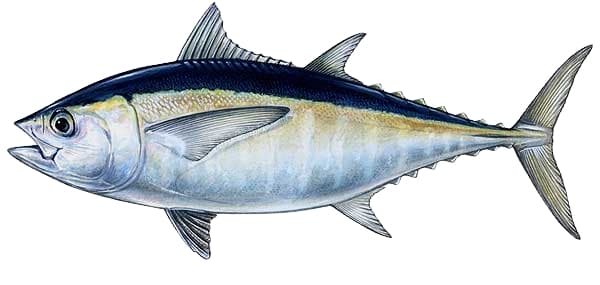
Blackfin Tuna
SaltwaterBeginner friendlyIn season now

Blackfin Tuna

Thunnus atlanticus

The everyman's tuna — the smallest Thunnus, but pound-for-pound a screaming little freight train that comes within reach of center-consoles and even kayaks off Florida and the Gulf. The realistic 'first tuna' for most anglers.

Typical size
5–20 lb
Trophy class
30 lb+
Easy-moderate

Find diving birds or a nearshore wreck, get a chum slick going or troll small feathers, then flat-line a live cigar minnow or drop a jig. Blackfin feed in fast, chaotic windows — be ready to cast the second they show.

Quick Catch Plan

Best bait right now
Live cigar minnow or pilchard flat-lined on 30 lb fluoro, small 1/0–2/0 live-bait hook
Recommended lure
Small vertical jigs (60–150 g) and trolled feathers/cedar plugs
Setup
7' medium-heavy spinning, 5000–6000 reel, 30 lb braid, 30–40 lb fluoro leader
Where to go
Nearshore wrecks, reefs, humps, and weedlines in 60–400 ft; birds and bait balls
Best time
Dawn and dusk; winter run off South Florida
Season notes
South Florida and the Keys get a strong winter–spring blackfin bite close to shore; the Gulf holds them around floaters and rigs much of the year.

ID Characteristics

Use these field marks and context clues to separate blackfin tuna from similar fish before logging or keeping one.

  • Overall look: The everyman's tuna — the smallest Thunnus, but pound-for-pound a screaming little freight train that comes within reach of center-consoles and even kayaks off Florida and the Gulf. The realistic 'first tuna' for most anglers.
  • Typical size: 5–20 lb; trophy class: 30 lb+.
  • Most likely setting: nearshore, offshore, reef, wreck in Florida, Gulf Coast, Southeast, Atlantic Coast.
  • Where to confirm it: Diving birds, breaking fish, bait balls, and temperature/color changes.
  • Compared with Skipjack tuna: Skipjack have 4–6 bold dark stripes on the lower belly; blackfin are clean-sided with dusky (not bright yellow) finlets.
  • Compared with Juvenile yellowfin: Yellowfin have bright-yellow finlets and a longer second dorsal; blackfin finlets are dark with only a faint bronze edge and the fish stays small.

Gear Recommendations

Rod
7' medium-heavy fast spinning (or light conventional for jigging)
Reel
5000–8000 spinning with a strong drag (20+ lb)
Main line
30–50 lb braid
Leader
30–40 lb fluorocarbon (drop to 25 lb when finicky)
Hooks
1/0–3/0 live-bait or circle hooks; 4/0 for larger baits
Jigheads
n/a; knife/vertical jigs 60–150 g
Terminal tackle
Long fluoro leader, minimal hardware; a small swivel for jigging
Lure sizes
Feathers/cedar plugs 4–6"; jigs 60–150 g
Lure colors
Blue/white, pink, and chrome; natural for live bait
Baits
Live cigar minnows · Live pilchards/threadfins · Chunk bonito/sardine · Small vertical jigs
Beginner setup

Book a nearshore charter or fish a known public wreck: chum, flat-line a live bait, hang on.

Budget setup

One 6000 spinning combo + a handful of jigs and a sabiki to catch your own bait.

Serious angler

Run-and-gun bird program with a livewell of cigar minnows, plus a light jigging setup for when they sound.

Techniques

Presentation
A lively free-lined bait in a chum slick, or a jig ripped up through a marked school. Light, near-invisible leader matters when they're pressured.
Retrieve
Jigging: fast, erratic lifts off the bottom or through mid-column marks. Bait: let it swim naturally, minimal weight.
Positioning
Up-current of the wreck/hump so the slick and baits drift back over the structure and marks.
Depth
Surface feeds to 300+ ft; jig the depth you're marking fish.
Structure
Wrecks, reefs, deep humps, weedlines, rips, and Gulf oil rigs/floaters.
Working current
Moving water stacks bait and turns the bite on; slack often shuts it off.
boat fishing

The main game — chum, troll, or jig around nearshore structure and bird schools.

kayak fishing

Very doable off South Florida in winter when blackfin push in near the reef line — jig or slow-troll a live bait.

Timing & Conditions

Seasons
Year-round in the Gulf around rigs; winter–spring peak off South Florida and the Keys.
Time of day
Low-light dawn/dusk is prime; overcast can extend it.
Weather
Fishable seas; birds work better on calmer mornings.
Wind
Light-to-moderate wind for nearshore comfort.
Water temp
Best 70–82°F.
Tides
Moving current over structure concentrates the bite.
Moon
Feeds around light changes; strong tides near the moons help.
Pressure
Minor.
Seasonal movement
Roam nearshore-to-offshore following bait; not a long migrator like the big tunas.

Habitat — Where to Find Them

Warm Atlantic and Gulf waters, often surprisingly close to shore over structure and along temperature breaks.

Depth range
Surface to ~600 ft; commonly caught 60–400 ft.
Look for
Diving birds, breaking fish, bait balls, and temperature/color changes.
Migration
Local seasonal movements rather than ocean-crossing runs.
wrecksreefsdeep humpsweedlinesoil rigsrips

Common Mistakes

  • Leader too heavy — blackfin are line-shy in clear water
  • Slow to cast when a school pops up (the window is seconds)
  • No chum or bait to hold the school at the boat
  • Fishing dead when there's no current
  • Bleeding/icing too late — tuna quality drops fast if not chilled immediately

Catch, Handling & Release

Landing
Gaff keepers cleanly behind the head; swing/net smaller fish.
Handling
Bleed and ice immediately — cut the gill arches and drop in an ice slurry for good table fare.
Release
Support the fish, revive with water over the gills, and release quickly — tunas fight to exhaustion.
Conservation
No federal minimum size for blackfin, but many states set bag limits (e.g., FL's Atlantic default of 2/person or 10/harvester where applicable) — verify current state rules before keeping.

Common Lookalikes

Skipjack tuna

Skipjack have 4–6 bold dark stripes on the lower belly; blackfin are clean-sided with dusky (not bright yellow) finlets.

Juvenile yellowfin

Yellowfin have bright-yellow finlets and a longer second dorsal; blackfin finlets are dark with only a faint bronze edge and the fish stays small.

Guide data is editorial and general — conditions, regulations, and fish behavior vary by water. Photo: Wikipedia — Blackfin tuna.